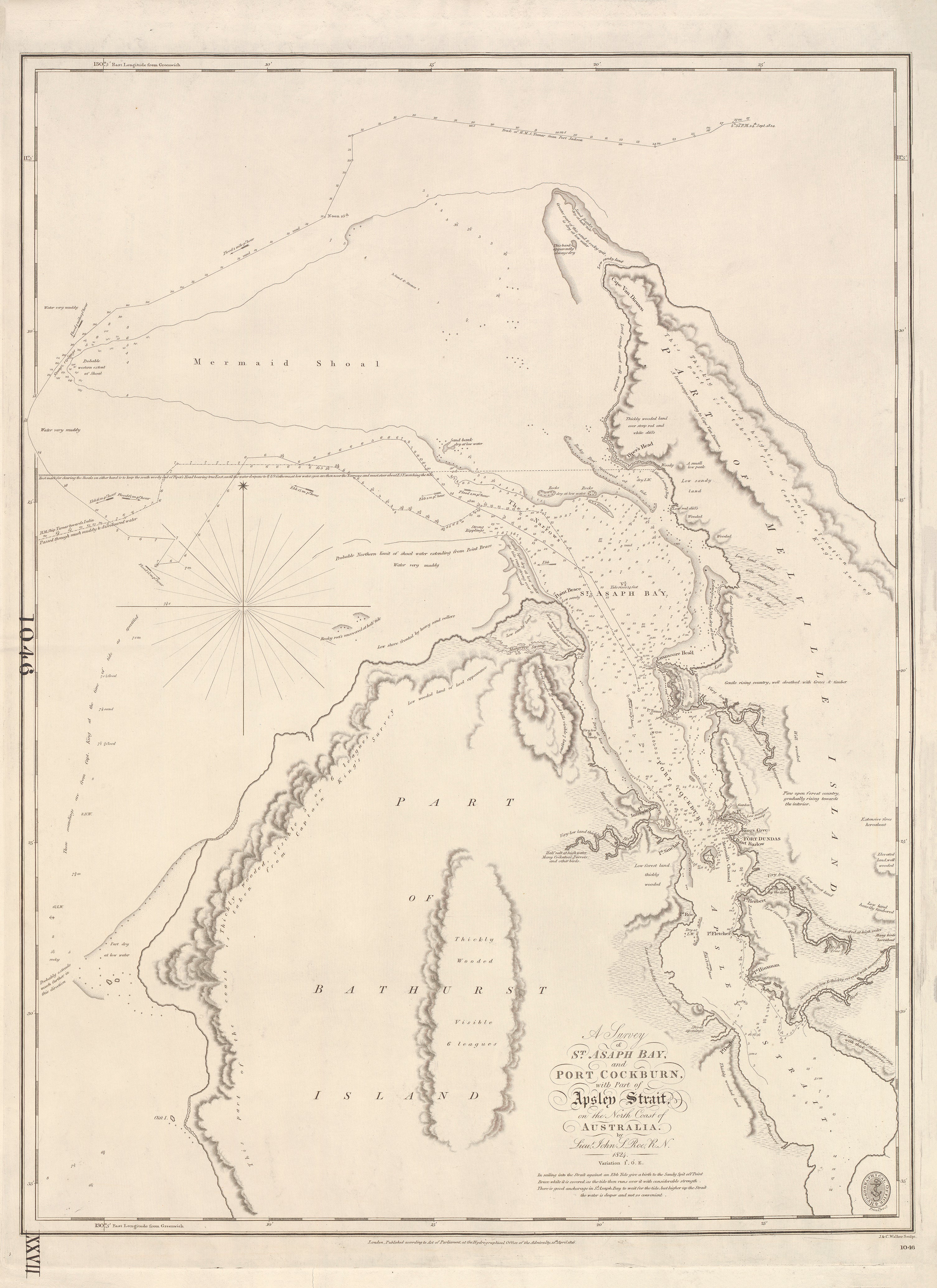
St. Asaph Bay & Port Cockburn — North Coast of Australia (1824–1826)
John Septimus Roe charts the gateways of Australia’s tropical north
This rare British Admiralty chart captures one of the earliest precise surveys of Australia’s far northern coastline. Drawn from the 1824 survey by John Septimus Roe, R.N., and engraved by the celebrated J. & C. Walker, it documents St. Asaph Bay and Port Cockburn—strategic anchorages between Bathurst and Melville Islands—with the clarity required for safe naval navigation.
Published by the Admiralty in 1826, this chart records the moment when the complex passages of Apsley Strait were first rendered intelligible to mariners operating at the edge of Britain’s Pacific reach.
This is not a decorative map.
It is a working chart from the opening of Australia’s Top End.
⚓ What This Chart Shows
This finely engraved Admiralty sheet presents the northern straits in navigational detail:
-
St. Asaph Bay and Port Cockburn with precise shorelines
-
Part of Apsley Strait, charting the passages between islands
-
Bathymetric soundings revealing depths, shoals and hazards
-
Coastal relief shown by classic Admiralty hachures
-
Track of H.M.S. Tamar from Port Jackson
-
Greenwich prime meridian — true Admiralty navigation standard
Every line reflects first-hand observation in waters then scarcely known to Europeans.
🧭 Why This Chart Works
Most maps show coasts.
This shows how ships actually moved through them.
-
Surveyed by John Septimus Roe — later Western Australia’s first Surveyor General
-
True British Admiralty production — the global standard for accuracy
-
High-resolution harbour and strait hydrography
-
Museum-grade engraving by J. & C. Walker
-
Direct insight into early northern exploration and defence
This chart is a cornerstone document of Australia’s northern maritime history.
✨ Premium Finishes
Every St. Asaph Bay & Port Cockburn (1826) Admiralty Chart is printed in Australia using archival methods to preserve the delicacy of the original engraving.
| Format | Description |
|---|---|
| 📜 Paper (160 gsm matte) | Smooth heavyweight archival paper with crisp line definition; ideal for framing under glass. |
| 🧼 Laminated (True Encapsulation) | 2 × 80-micron gloss laminate, edge-to-edge protection; tear-resistant and wipe-clean. |
| 🖼️ Canvas (395 gsm HP Professional Matte) | Pigment-based, fade-resistant inks for a warm, gallery-grade finish. |
| 🪵 Laminated + Timber Hang Rails | Natural timber rails with hanging cord; ready to hang. Allow up to 10 working days. |
| 🪵 Canvas + Timber Hang Rails | Elegant frameless presentation with lacquered natural timber rails. Allow up to 10 working days. |
📐 Size
730 mm (W) × 1000 mm (H)
A tall portrait format that suits the north–south passages of the Apsley Strait and surrounding bays.
🎯 Ideal For
-
Australian exploration and naval history collectors
-
Museums, libraries and universities
-
Northern Australia heritage interiors
-
Anyone fascinated by the opening of the Top End
🤝 Our Commitment
-
Printed in Australia with professional colour management
-
Archival pigment inks for long-term colour stability
-
Premium laminates and canvas for durability
-
Natural timber hang rails for refined presentation
-
Hand-checked and carefully packed before dispatch
From first survey to safe passage, this chart marks the opening of Australia’s tropical north.
Choose your finish and bring this rare Admiralty map onto your wall.